Your HMO licence wants more than a standard EICR... the electrics that actually get checked
Written by B.P.H. Electrics
NAPIT-registered, Part P electrician. Family-run, based in Slough, covering Slough, Windsor, Maidenhead, Reading and the wider Thames Valley.
If you let an HMO around Slough, here's the trap I watch landlords walk into. You book a standard EICR, it comes back satisfactory, you file it and assume you're covered for five years. On an ordinary buy-to-let, you would be. On a licensed HMO, that certificate is the floor... not the finish.
The five-year EICR is the legal minimum, not the whole job
The five-year EICR is the bit everyone knows... the national rule under the Electrical Safety Standards Regulations 2020, and it's the same test for a one-bed flat as a five-person shared house. But here's what I keep seeing in shared houses round here: the compliance folder stops there. A satisfactory EICR on top, and underneath it, nothing for the alarms and nothing for the emergency lights. That folder passes one rulebook and quietly fails the other. That test is my inspection and testing bread and butter.
The catch is that your HMO licence is a separate document with its own conditions... and those are set by your council, not by the 2020 Regs. Many councils' licence conditions ask for more than the legal minimum: an EICR every three years rather than five is common, and some want a fresh one when the licence changes hands. None of that is in the 2020 Regs. It lives in the small print of your licence, which is why I always tell landlords to read their actual conditions rather than assume five years covers them. Check your own council (Slough, Hillingdon if you're out toward Uxbridge or Hayes, RBWM for Windsor and Maidenhead) because they don't all say the same thing.
What actually gets checked on an HMO
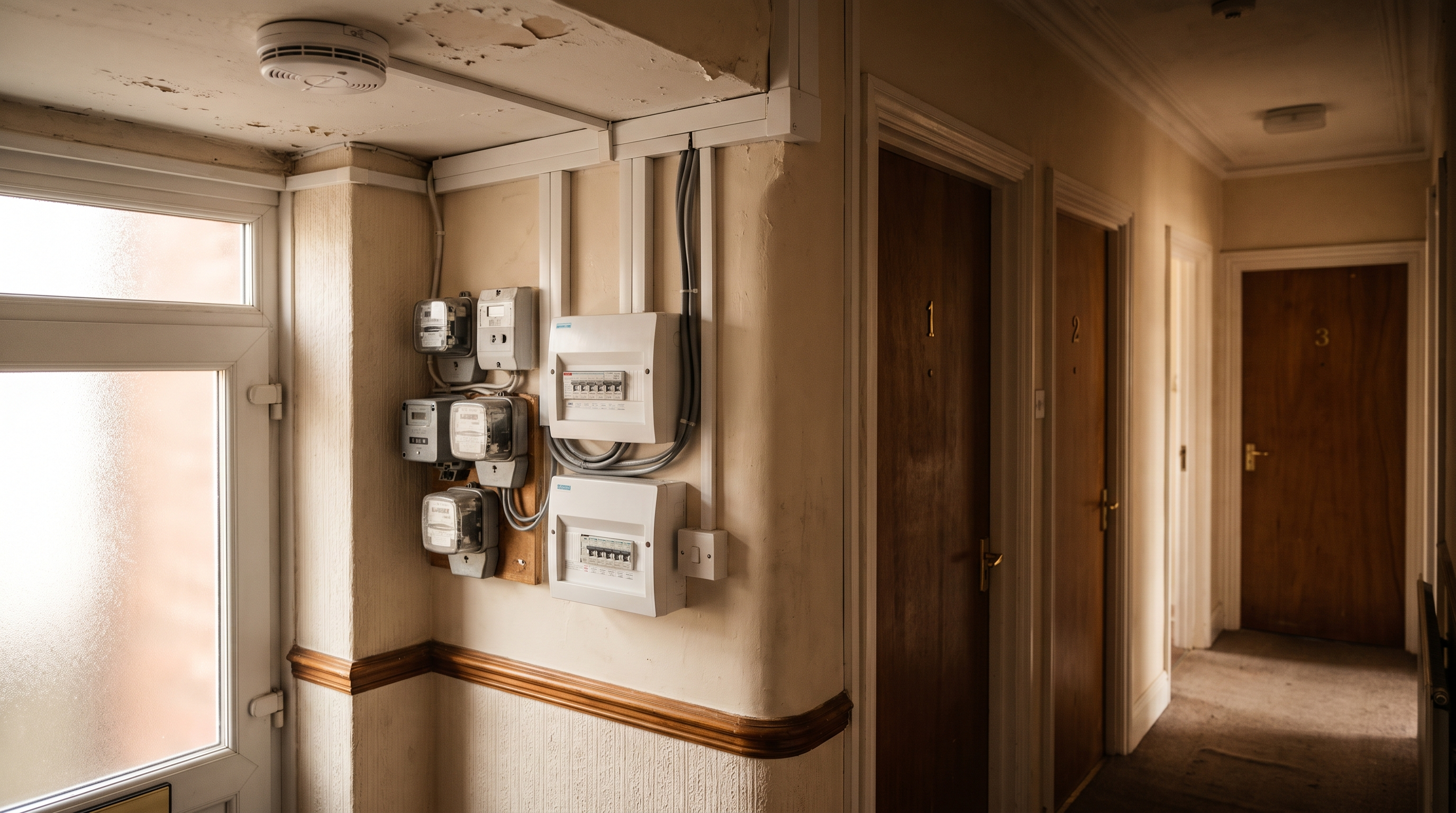
An HMO EICR also reaches further than a single-let one. It should take in the communal areas (the hall and landing lights, the shared consumer unit, the sockets on the stairs) plus the wiring feeding the fire-alarm system and any outbuilding or garage circuit. The parts tenants never think about are exactly the parts a licence inspection cares about.
Fire detection and emergency lighting are their own regimes
I've had this conversation more than once in a Chalvey stairwell. The landlord hands me a satisfactory EICR, dated and filed, genuinely convinced he's covered. Then I kill the landing lights and the staircase, the only way out of the building, goes black. Nothing wrong with the EICR. It just never claimed to check that. The fire-alarm and emergency-lighting checks are not part of your EICR. They're separate standards with separate certificates.
Interlinked fire detection is designed to BS 5839-6. The grade and coverage depend on the property, a two-storey house and a three-storey conversion don't get the same system, and it needs its own periodic testing by a competent person.
Emergency lighting in escape routes is designed and tested to BS 5266-1, again on its own schedule, not folded into the EICR.
So a "satisfactory EICR" tells you nothing about whether your alarm grade is right or your emergency lights hold up in a power cut. Three jobs, three certificates.
Two rulebooks, two ways to get caught
This is the bit worth sitting with. The 2020 Regs and HMO licensing run in parallel, and each can penalise you on its own. Breach the electrical regs and the council can impose a financial penalty of up to £40,000 per breach (raised from £30,000 in May 2026). Fall short on your licence conditions (or run a licensable HMO without a licence at all, an offence under the Housing Act 2004) and that's separate enforcement again. Passing one doesn't buy you off the other.
The Slough angle
Slough is HMO country... Chalvey and the streets round the town centre are full of them, and the council knows it. If you hold a portfolio here, the safe move is to treat the EICR, the alarm certificate and the emergency-lighting test as three standing jobs on a calendar, and to read your own licence conditions for the interval and any change-of-holder wording. "I thought it was five years" isn't a defence.
Getting it straight
I'm a NAPIT-registered electrician based in Slough, and I test HMOs across the town and the wider Thames Valley... the EICR, the communal circuits and the wiring behind the life-safety systems. Whether you've got one property or a dozen and you're not sure your paperwork lines up with your licence, get in touch through my Slough page for a free, no-obligation quote and I'll tell you straight where you stand.
Got an Electrical Job in Mind?
Friendly, fully-qualified and local. Call B.P.H. Electrics for a straight answer.
Call +44 7722 132736