Smart light switch won't work? It's the missing neutral... and how I get round it
Written by B.P.H. Electrics
NAPIT-registered, Part P electrician. Family-run, based in Slough, covering Slough, Windsor, Maidenhead, Reading and the wider Thames Valley.
So you ordered a smart light switch online, watched a two-minute video, turned the power off, swapped it in... and now it's flashing at you, buzzing quietly, refusing to stay on, or the lights won't turn off properly. Before you leave a one-star review, it's almost certainly not faulty. It's missing a wire. Specifically a neutral... and in most UK homes, there simply isn't one behind the switch.
Why there's no neutral behind your switch
To understand the problem you have to know how the lighting in a typical British house is wired. It's called loop-in wiring, and it's been the standard for decades.
Instead of running everything through a separate junction box, the ceiling rose, the round fitting your light hangs from, does that job. The permanent live and neutral loop from rose to rose across the ceiling. From each rose, a single cable drops down the wall to the switch. That cable carries the live down and a "switched live" back up when you flick it on. The neutral stays up at the ceiling. It never goes near the switch.
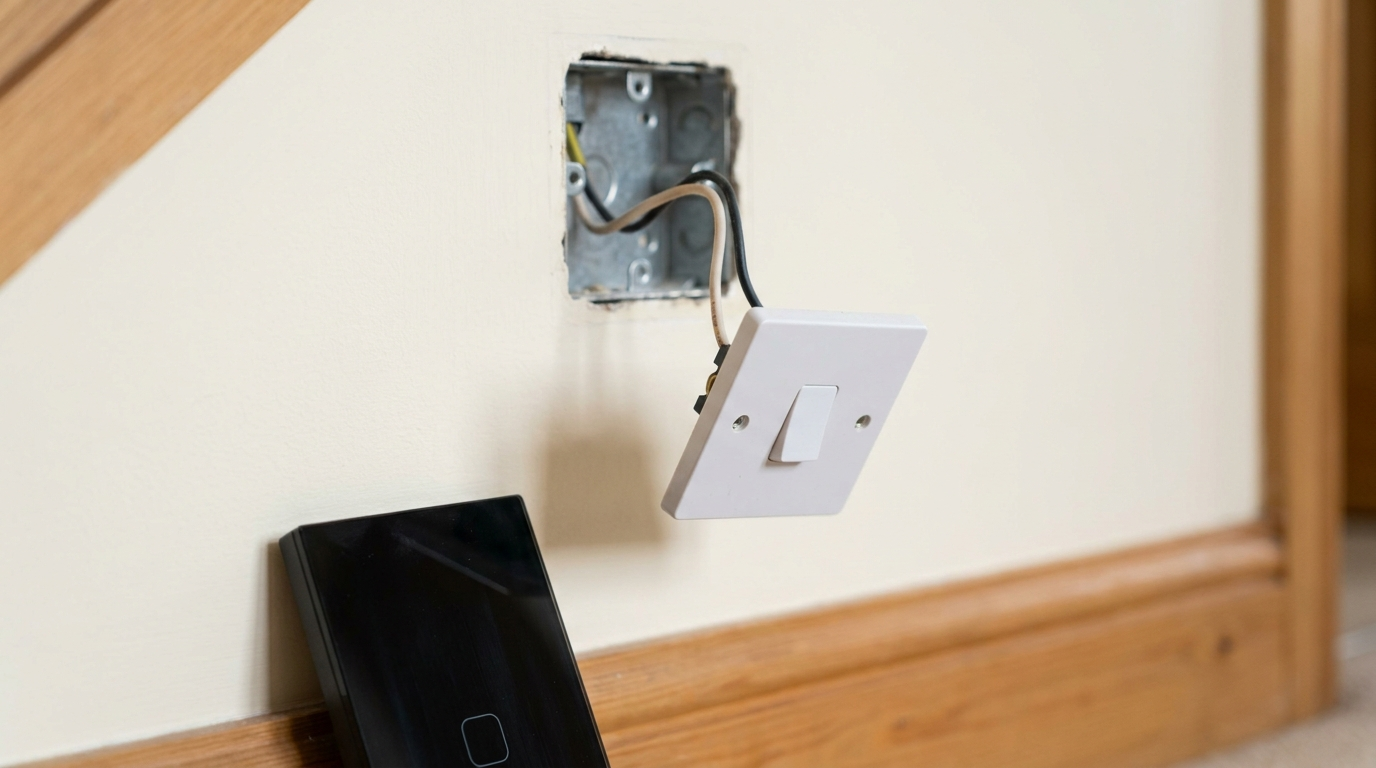
There's a good safety reason for it: a switch should always break the live conductor, so the fitting is properly dead when it's off and you're not changing a bulb on a live lampholder. The upshot is that when you unscrew an old switch, you'll usually find two wires that are both live... no neutral in sight. You'll often spot the blue wire wrapped in a bit of brown or red tape; that's the switched live, sleeved to warn that it isn't a neutral.
Why the smart switch needs one
A plain switch is just a mechanical contact. It doesn't need any power itself... it simply makes and breaks the circuit. A smart switch is a little computer. It has to stay awake to listen for your phone, the app or your voice, even when the light is off. To do that, it needs a constant supply of its own: a live and a neutral.
The "no-neutral" models get around this with a clever trick. They trickle a tiny current down the switched live, through your light fitting and back to the neutral up at the ceiling... just enough to keep the electronics alive. That works right up until it doesn't. With modern LED bulbs, which need barely any power to run, that trickle can be enough to make them glow faintly when they should be off, flicker, or flash. That's the fault you're seeing. The switch isn't broken; it's starved of a proper neutral and borrowing current through your bulbs.
The real options (and when each makes sense)
There are four honest ways to sort it, and which one I'd point you at depends entirely on your house and what you're trying to achieve.
A no-neutral smart switch. These are designed for exactly this situation, and on the right circuit they're the tidiest fix... the smart bit lives in the wall and nothing changes at the ceiling. The catch is they can be fussy about the bulbs and the load. To stop the flicker they often need a small "bypass" capacitor wired in at the light fitting, which means getting up to the rose anyway, and even then some LED bulbs just won't play nicely. When they suit the job they're great; when they don't, you can chase your tail.
A relay module at the light fitting. This is the one I reach for most. Instead of putting the smart electronics in the switch, I fit a small smart relay module up at the ceiling rose or behind the fitting, where there's a neutral sitting right there. Your existing wall switch stays put and becomes the trigger, so it still works normally for anyone who just wants to turn the light on and off. It's reliable, it doesn't depend on borrowing current through the bulb, and it keeps ordinary wall control for guests who've no interest in an app. The only real requirement is enough room behind the fitting for the module.
Running a proper neutral to the switch. If you've set your heart on a particular switch that genuinely needs a neutral, I can run a new cable from the ceiling down to give it one. It's the most robust answer, but it usually means lifting a floor or chasing the wall, so it makes most sense during a redecoration, a rewire, or when the plaster's coming off anyway.
Smart bulbs instead. Sometimes the simplest answer is to skip the switch entirely and use smart bulbs, controlled by app or a little wireless remote. Good for a lamp, a bedside light or one feature fitting. The snag is the wall switch: if someone flicks it off at the wall, the bulb loses power and stops being smart. For a whole house of people who aren't all app-minded, that gets old fast.
What's involved when I do it properly
When someone asks me to make their lighting smart, the switch is the last thing I look at. First I want to see what's actually behind it... how many wires, whether there's any prospect of a neutral, and how deep the back box is, because a lot of smart switches need a deeper box than the shallow ones fitted years ago. Then I look at the ceiling rose to see if there's room for a module and a neutral to connect to. Only then can I tell you honestly which of the four routes fits, rather than selling you a box that may or may not work.
It's worth knowing where this sits with the rules, too. Swapping a switch like-for-like is generally non-notifiable work, but it still has to meet the wiring regulations (BS 7671), and anything in or near a bathroom, or any brand-new circuit, is a different matter and notifiable under Part P. Either way I test and certify what I install... that little Minor Works certificate is your proof it was done properly, and it matters if you ever come to sell or let the place. If you want the wider detail on how I approach a job, the lighting installation page covers it.
A word to the smart-home crowd
I do a fair bit of this around Gerrards Cross and Beaconsfield, where people are kitting out whole houses... every room on the app, scenes, the lot. The pattern I see again and again is someone who's bought a lovely set of switches online, got two of them working, and hit a wall on the rest because half the house has no neutral and the back boxes are too shallow. It's very fixable, usually with relay modules at the fittings... but it's a lot less painful to plan the approach before you've bought fifteen switches, not after.
If you're thinking about smart lighting, one room or the whole house, I'm happy to take a look at what you've actually got and tell you straight what'll work. I cover Slough, Windsor, Maidenhead and across the Thames Valley, Gerrards Cross and Beaconsfield included. Get a free no-obligation quote and we'll work out the tidiest way to get your lights doing what you want.
Got an Electrical Job in Mind?
Friendly, fully-qualified and local. Call B.P.H. Electrics for a straight answer.
Call +44 7722 132736