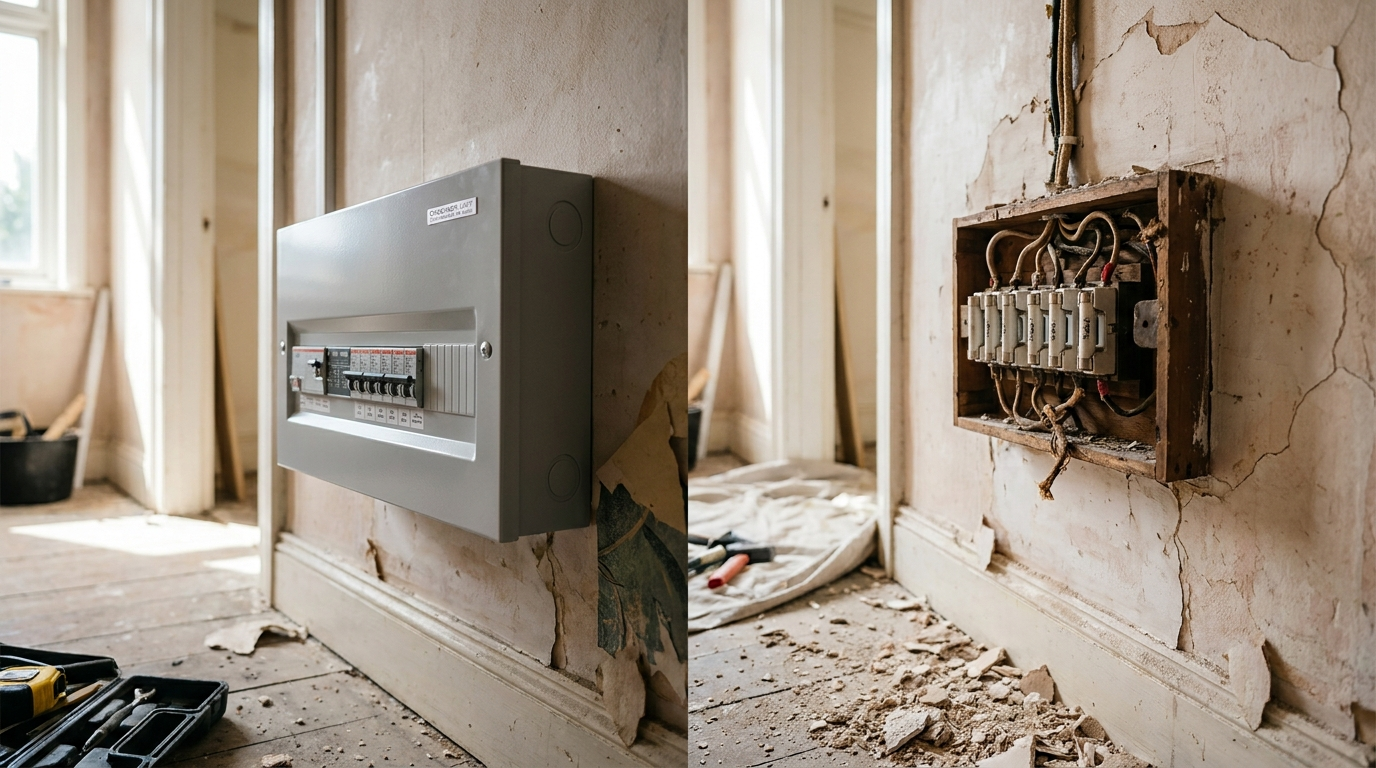
"Just stick a new fuse box on it"... why a new consumer unit won't fix knackered old wiring
Written by B.P.H. Electrics
NAPIT-registered, Part P electrician. Family-run, based in Slough, covering Slough, Windsor, Maidenhead, Reading and the wider Thames Valley.
It's one of the most common requests I get: "Can you just stick a new fuse box on it?" Usually because someone's been told the old board is out of date, or a survey flagged it, or the house is being sold and a buyer wants RCD protection. And fair enough... an old board with rewireable fuses and no RCD is worth changing.
But there's a catch that trips a lot of people up, sometimes literally, and it's worth understanding before you part with the money.
The board is the brain, not the arteries
Think of your consumer unit as the brain of the electrics. It monitors, it decides, and it switches things off the instant something's wrong. The cables buried in your walls and running under your floors are the arteries... they're what actually carry the power around the house, and, frankly, they're where most faults live.
Changing the board gives you a smarter, more alert brain. It does nothing whatsoever to the arteries. If your wiring is tired, a new board doesn't heal it. It just watches it far more closely than the old one ever did... which, as we'll see, is a mixed blessing.
Why a shiny new board can trip from day one
The whole reason to fit a modern board is that it's more sensitive. Under the 18th Edition wiring regulations, new consumer units come with RCD or RCBO protection on the circuits... devices that cut the power the moment they detect current leaking to earth. That's a real, worthwhile safety upgrade.
But here's what nobody warns you about: old cables leak. Rubber-insulated and early PVC cable, think anything wired before the 1990s, goes brittle with age, cracks at the bends, and lets small amounts of current escape to earth, especially when it's damp or the circuit's working hard. Your old board, with no RCD or a single insensitive one, never noticed. It ran happily for years alongside leakage that modern regulations wouldn't tolerate for a second.
Fit a sensitive new board onto that same tired wiring and it does exactly what it's designed to do: it detects the leakage that was there all along, and it trips. Sometimes constantly, from the first damp morning. People phone me convinced the new board is faulty. It almost never is. The new board is telling you the truth about your wiring that the old one was too deaf to hear. Swapping the board again to shut it up doesn't fix anything... you'd just be shooting the messenger.
What I test before I'll quote a board change
This is the honest bit. Before I'll quote you for a straight board swap, I test the wiring it's going to sit on. That means inspecting the installation and, in particular, doing insulation resistance testing on the existing circuits... essentially measuring how well each cable is still holding the electricity in. It doesn't take long, and it tells me whether your wiring can actually live with a modern board or whether it's going to fight it.
Depending on what those tests show, you'll get one of three honest answers from me:
Your wiring's sound... a board change is exactly right. You get the full safety benefit and no nasty surprises.
Your wiring's mostly fine but one or two circuits are shot... so the sensible job is a board change plus rewiring those specific circuits, done together while everything's open.
Your wiring's had it across the board... in which case I'll tell you a rewire needs to come first. A new consumer unit on cable that's already failing is just money spent to be told, loudly and repeatedly, that you needed a rewire.
I know "you need more than you asked for" is about the least popular sentence in this trade... which is precisely why some people avoid saying it and just fit the board you asked for. I'd rather you heard it from a meter before the work than from a tripping board afterwards.
When a board change on its own IS the right job
None of this means every board change is a can of worms. Plenty of the time a straight swap is spot on, and I'll happily crack on with it. The sweet spot is a house with decent wiring but an old board: sound cable in good nick, but rewireable fuses, no RCD protection, maybe a main switch that's gone warm or crackly. Good arteries, old brain. That's a proper upgrade that makes the house safer the same day... and it comes with a full test and a certificate, which matters more than the shiny new box (more on that in a second).
The plastic-versus-metal thing, in one paragraph
Quick myth to put to bed. Since 2016, new consumer units in homes have had to be made of non-combustible material (metal, in practice) after a run of fires linked to faulty connections inside plastic boards. That change is not retrospective. If you already have a plastic board that's in good condition and doing its job, it is not suddenly illegal and you are not obliged to rip it out. The metal-enclosure rule only bites when the board is actually being replaced. Anyone telling you your existing plastic unit is "against the law" and must go today is, at best, overstating things.
A word on the paperwork
Whoever you use for this, it matters: a consumer unit change is notifiable work. In England and Wales it has to be registered with Building Control (I handle that for you as a registered electrician), it requires full testing of the installation, and you should be handed an Electrical Installation Certificate at the end. If a new board goes on and no certificate comes out, a corner has been cut. That bit of paper is your proof the wiring was actually tested... not just that the box on the wall got swapped.
Why I see this most on certain streets
I notice this pattern most on whole roads that went up together. A lot of Bracknell's new-town housing was wired in the same handful of years back in the fifties, sixties and seventies... which means the original boards, and a fair bit of the original cable behind them, are now well past retirement age, street after street. Same story with the older ex-council stock around Slough: a whole road wired to the same spec in the same year, same board on every wall.
So when one neighbour's "quick board change" turns into "actually, these two circuits want doing as well," it's usually not anyone being upsold. It's that the whole street's arteries are the same age... and yours are telling the same story as next door's.
If your board's on its way out, the right first move is to find out what's behind it. Book a free, no-obligation quote at bphelectrics.co.uk and I'll test the wiring, tell you straight whether it's a fuse box replacement or something more, and price the job you actually need... not the one that's easiest to sell. You can also reach me on +44 7722 132736. I'm Billy, a NAPIT-registered electrician covering Slough, Windsor, Maidenhead, Bracknell and the wider Thames Valley.
Got an Electrical Job in Mind?
Friendly, fully-qualified and local. Call B.P.H.Electrics for a straight answer.
Call +44 7722 132736