Getting a tingle off the tap or washing machine? That's an earthing fault, not static
Written by B.P.H. Electrics
NAPIT-registered, Part P electrician. Family-run, based in Slough, covering Slough, Windsor, Maidenhead, Reading and the wider Thames Valley.
You brush past the washing machine mid-cycle and feel a faint buzz through your hip. Or you turn the cold tap and get a little nip up your fingers. Someone in the house says "oh, it does that sometimes," and everyone gets on with their day.
Please don't get on with your day. That tingle isn't static, it isn't one of those charming quirks of an old house, and it is never normal. It's mains electricity looking for a way to earth... and the way it has found is you.
What the tingle actually is
Every appliance and every bit of metal plumbing in your home is meant to have a safe, low-resistance route back to earth. If a live wire inside an appliance rubs through its insulation, or damp creeps into a connection, a small amount of current leaks onto the metal casing or the pipework. When your earthing is doing its job, that leakage runs harmlessly down the earth conductor... and if it's bad enough, it trips your RCD and cuts the power. You never feel a thing.
The tingle happens when that proper earth path is missing or has gone high-resistance. The leakage still wants to reach earth. If the easiest route it can find is through your hand, across your chest and out through your feet on a damp kitchen floor, that's the route it takes. What you feel as a "buzz" is current passing through your body. It's usually small. The problem is it doesn't have to stay small.
Why it's so often the bonding that quietly disappeared
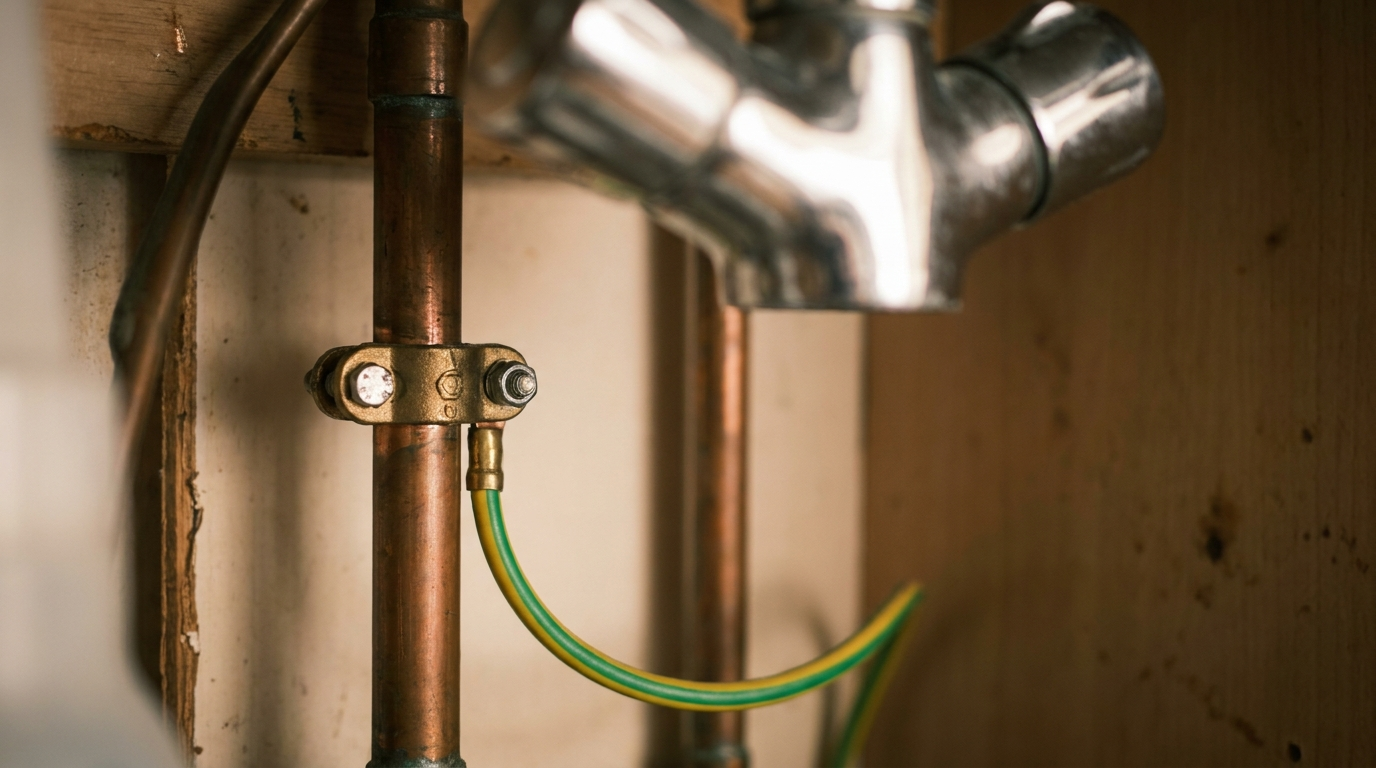
Here's the part most people have never heard of. Running from your fuse box is a thick green-and-yellow cable called main protective bonding. It clamps onto your incoming metal gas and water pipes (close to where they enter the house, within about 600mm of the entry point) and its job is to tie all that metalwork to the same safe electrical potential as everything else. Get that right and there's no voltage difference to push current through you.
Now the trap. The moment a length of your incoming metal water pipe gets swapped for plastic (during a boiler change, a bathroom refit, a leak repair) the earth path through that pipe can be broken. The bonding clamp might still be sitting there on a stub of copper under the sink, looking for all the world like it's connected. But if the run back out to the street is now plastic, that copper no longer reaches real earth. The bonding is orphaned. Nobody did anything wrong on purpose, a plumber isn't there to check earthing and often can't see the whole picture, but your metalwork has quietly lost its reference to earth, and nobody knew until someone felt a shock.
This is the classic Windsor and Eton problem. A lot of that period housing has been plumbed and re-plumbed across decades: a bit of lead swapped for copper here, a section of copper swapped for plastic there. You end up with a patchwork where the original earth path was cut years ago without anyone noticing. I regularly find bonding clamps hanging on hopefully to pipes that go nowhere near earth anymore.
Why it can get worse, not better
A tingle today is a warning, not a settled state. The fault that's leaking a little now (perished insulation, a loose earth, damp in a connection) tends to worsen over time, not heal. And with no proper earth path, there's nothing to trip and cut the supply. That's the whole point of earthing and an RCD working together: a dangerous fault is supposed to disconnect itself in a fraction of a second. Take away the earth path and a fault that should have flipped a switch instead just sits there, live, waiting for someone to complete the circuit.
It takes surprisingly little current to matter... in the order of 30 milliamps through the wrong path is enough to stop a heart, which is exactly why RCDs are set to trip at that level. That's not me trying to frighten you. It's why I treat "we get a little shock off the tap" as an urgent-adjacent job, not something to pencil in for a fortnight's time.
What to do right now
Stop using the appliance or fitting that gives you the tingle. Switch it off, and unplug it if it's an appliance.
Don't start investigating it yourself. You can't diagnose an earthing fault by eye, and unscrewing pipe clamps or opening up an appliance to "have a look" is exactly the wrong move around live metalwork.
Make a note of what shocks you and when... every tap or just one, the washing machine only mid-cycle, worse when it's damp.
Call an electrician and say plainly that you're getting shocks. If more than one person has felt it, or it's a child or someone with a heart condition, treat it as an emergency and get it seen the same day on my emergency callout line.
What I actually check
When I come out to a tingle complaint, I'm not guessing... I'm measuring. There are three things it usually comes down to, and I test for each:
The main protective bonding... is it actually there, correctly sized, and clamped to pipework that genuinely reaches earth? Or is it orphaned on a plastic-fed run, doing nothing?
Earth continuity... does the earth path from that appliance or fitting actually make it back to the fuse box with low enough resistance to do its job when it's needed?
Leakage... how much current is escaping, and from where? That's how I tell an appliance fault from a wiring fault from a bonding problem.
Half the job is working out which of those three it is, because the fix for each is completely different. Sometimes it's a five-minute re-bond. Sometimes it's a knackered appliance that needs binning. Occasionally it's a wiring fault that's been hiding for years. Tracing it properly is what my fault finding work is for, and confirming the earthing and bonding are sound across the whole installation is part of a proper inspection and testing visit. Either way, I'd rather find the fault with a meter than have you find it with your hand.
If anything in your home is giving you a shock, don't sit with it. Book a free, no-obligation quote at bphelectrics.co.uk... or if people are getting shocks right now, call me straight away on +44 7722 132736. I'm Billy, a NAPIT-registered electrician covering Slough, Windsor, Maidenhead and across the Thames Valley, and earthing faults like this are bread-and-butter work.
Got an Electrical Job in Mind?
Friendly, fully-qualified and local. Call B.P.H.Electrics for a straight answer.
Call +44 7722 132736