"Can I just plug my new oven into a normal socket?"
Written by B.P.H. Electrics
NAPIT-registered, Part P electrician. Family-run, based in Slough, covering Slough, Windsor, Maidenhead, Reading and the wider Thames Valley.
The socket came off the wall soft. I had the range cooker pulled out in a Bracknell kitchen, torch on the wall behind it, and when I got a screwdriver to the faceplate the plastic had that gone-to-toffee feel... slightly bowed, the sheen melted off it, one of the pin holes browned round the edge like a cigarette burn. It smelled of hot plastic, that sweet chemical whiff you never quite forget. Behind it the terminals were discoloured and one screw had cooked black.
Nobody had done anything mad. They'd bought a big oven, it came without a plug, so someone had "helpfully" wired a 13A plug onto the tail and run it off the nearest kitchen socket. It worked. For a few months it worked fine... which is exactly the problem, because "it worked" and "it's safe" are not the same sentence.
The question everyone actually types
"Can I just plug my new oven into a normal socket?" It's one of the most searched questions in the country, and the honest answer is the annoying one: it depends. It depends on one thing you can check yourself in about ten seconds... the rating plate on the appliance.
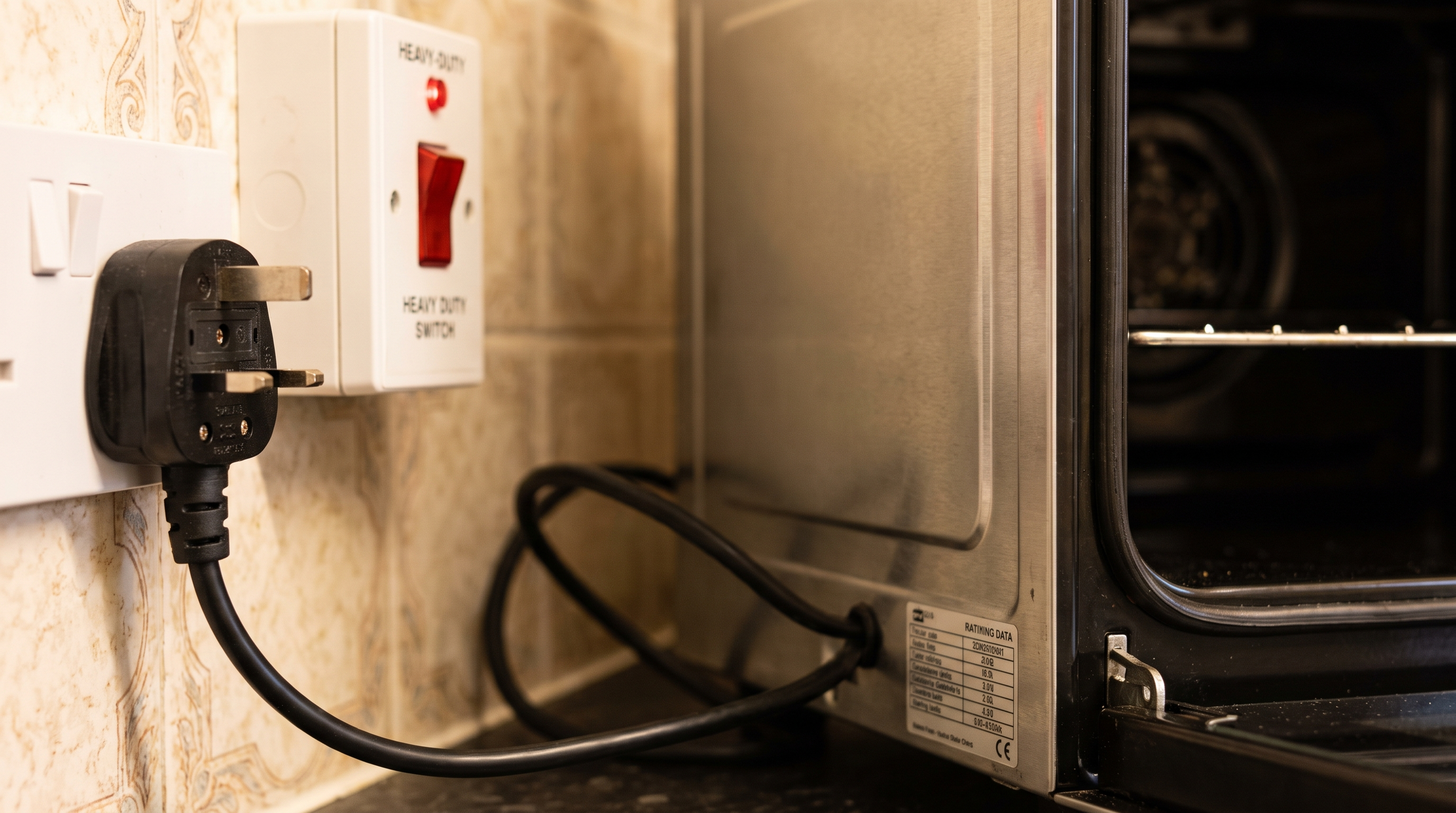
Not the marketing. Not the showroom sticker. The little metal or foil plate, usually round the door frame or on the back, that tells you the actual kilowatt rating.
The arithmetic a 13A plug can't argue with
A standard 13A plug and socket, on our 230V supply, tops out at around 3kW. That's not opinion, it's sums: 13 amps times 230 volts is about 2,990 watts. Call it 3kW and you're at the ceiling.
So the rule of thumb writes itself:
A single oven rated at roughly 3kW or under will usually turn up with a proper 13A plug already moulded on, and it's designed to go straight into a normal socket. That's the easy case, and it's most single ovens.
Anything above about 3kW (most double ovens, range cookers, and the beefier single ovens) is over what a 13A plug can safely carry. These are meant to be hardwired into a dedicated cooker circuit, through a cooker control unit (that big switch with the neon you see beside the worktop).
One catch worth knowing: a few single ovens sit just under 3kW but the manufacturer's instructions still say connect it to a fused spur or a dedicated point, not a plug and socket. So read the actual install sheet... if it says no plug, it means no plug.
Why the too-big oven cooks the socket
Here's what was happening behind that Bracknell range. The appliance wanted well over 13 amps. It pulled it anyway... a socket doesn't refuse, it just heats up. And this is the bit that catches people: the 13A fuse in the plug doesn't necessarily save you. Fuses and breakers are there for a sudden fault or a dead short. A socket run slightly over its limit for hours a day doesn't blow anything... it just sits there getting warm, then hot, then the plastic starts to give, then the connections loosen and arc. The plug melts long before the fuse ever pops.
Same principle I bang on about with electric showers... it's never the appliance that's the danger, it's whether the thing feeding it can carry the load. The oven decides how much current. The circuit decides whether that's safe.
It gets worse if the oven's been run off a daisy-chain... an extension lead, or a socket that's already sharing a hob or a microwave. Now you're stacking loads on wiring that was sized for a phone charger and a kettle, and the melted faceplate is just a matter of when.
What a big oven actually needs
A double oven or range wants its own dedicated circuit run from the consumer unit... its own breaker, cable sized for the job, and a cooker control unit to isolate it. That's a proper bit of work, not a swap.
It's also notifiable under Part P in England: a brand-new circuit has to be either signed off by a registered electrician who can self-certify it, or notified to building control. That's not red tape for its own sake... it's the paper trail that says the cable and protection were actually sized for the load. Handy to have when you sell the house, too.
The good news round here is that a lot of Bracknell's houses, the new-town streets thrown up from the fifties through the seventies, already have an old cooker circuit sitting behind the units, even if the last people ripped the cooker out and forgot it existed. Sometimes I can bring that back into use. Sometimes it needs upgrading. I can't tell you which without lifting the cover and looking, but it often means a dedicated cooker circuit off the board is more straightforward than you'd fear.
The ten-second check before you buy
Before you order anything, find the kilowatt rating... on the appliance, or in the spec on the product page.
Single oven, 3kW or under, comes with a plug → normal socket is usually fine.
Double oven, range, or anything over ~3kW → dedicated cooker circuit, hardwired. No plug.
Rating plate or install sheet says "fused spur" / "must not be connected to a 13A socket" → believe it, whatever the kW.
And if you're staring at a socket behind the cooker that's discoloured, warm to the touch, or smells faintly of hot plastic... stop using it. That's not cosmetic. A browning socket is a symptom, not a look.
Not sure what your kitchen can take?
If you've got a new oven on order and you're not certain the circuit behind the units can handle it, that's a five-minute look for me and a lot of grief saved for you.
I'm a NAPIT-registered electrician based in Slough, covering Windsor, Maidenhead, Bracknell, Staines and the Thames Valley. I'll check what's actually in the wall and tell you straight whether it's a plug-in job or a proper cooker circuit... for a free, no-obligation quote, get in touch at bphelectrics.co.uk.
Got an Electrical Job in Mind?
Friendly, fully-qualified and local. Call B.P.H.Electrics for a straight answer.
Call +44 7722 132736