Written by B.P.H. Electrics
NAPIT-registered, Part P electrician. Family-run, based in Slough, covering Slough, Windsor, Maidenhead, Reading and the wider Thames Valley.
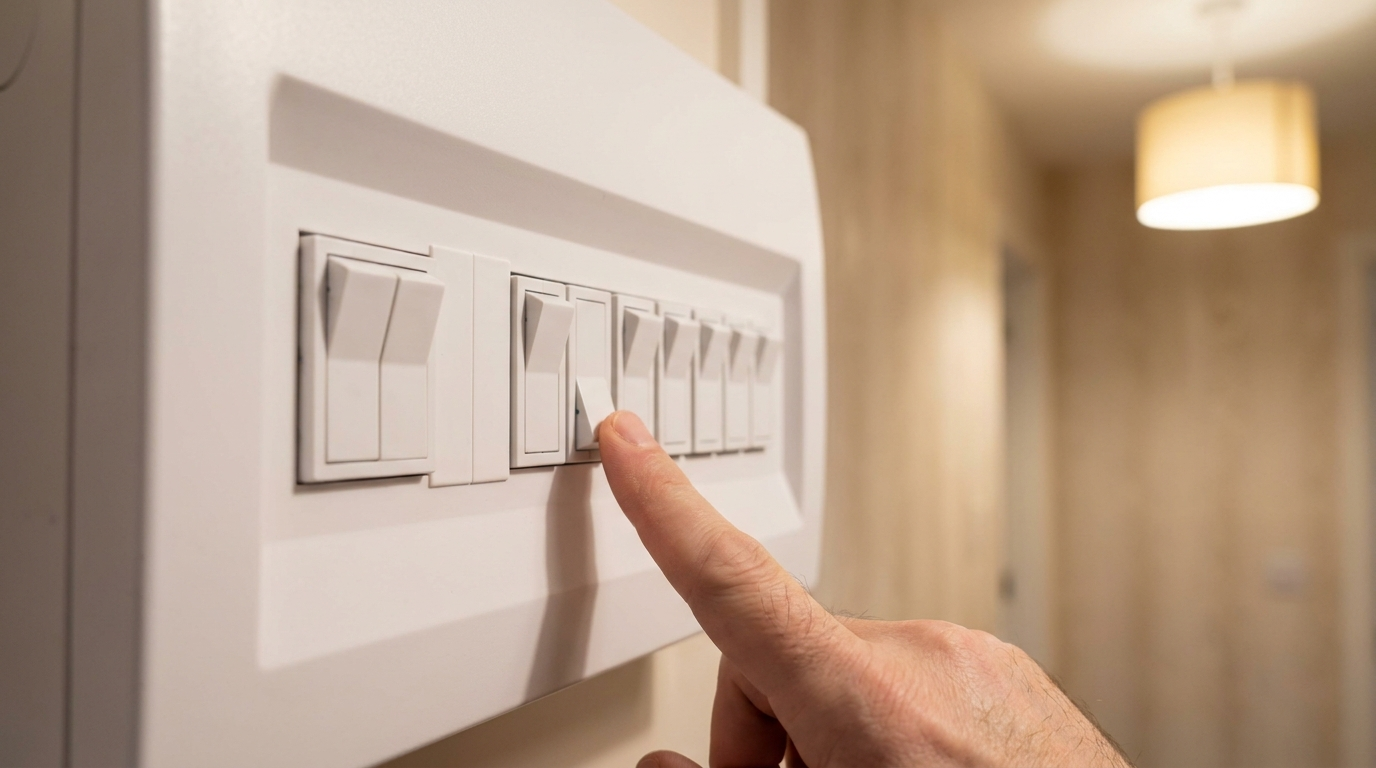
It's one of the most frustrating household problems there is. You're going about your day, and suddenly the power cuts out. You head to the fuse box, find a switch has flicked to "off", push it back up... and either everything's fine, or it trips straight back off again an hour later. So what's going on, and should you be worried?
That switch is your RCD, and it tripping is usually a good sign... it means a safety device is doing exactly what it's meant to. Here's what's actually happening, the common causes, and a simple check you can safely do yourself before picking up the phone.
First, what is an RCD... and why does it trip?
RCD stands for residual current device. It's a safety switch in your consumer unit (fuse box) that constantly monitors the flow of electricity. If it detects even a tiny amount of current leaking somewhere it shouldn't (for example, to earth through a fault, or through a person) it cuts the power in a fraction of a second. That speed is what protects you from a serious electric shock.
So an RCD trip isn't a fault in itself. It's your electrics detecting a leak and shutting off to keep you safe. The job is to find what is leaking. A quick note on terminology: an RCD trips on leakage to earth, whereas an MCB (the individual circuit switches) trips on overload or a short circuit. If a switch is flicking off under heavy load rather than randomly, that may be an MCB doing a slightly different job... but the detective work is similar.
The most common causes
In our experience, the culprit is almost always one of these:
A faulty appliance. This is by far the most common cause. Appliances with heating elements or motors (kettles, washing machines, dishwashers, tumble dryers, older fridges and freezers, immersion heaters) can develop a tiny leak to earth as they age. It's often just enough to trip the RCD, particularly when the appliance is under load (a washing machine mid-cycle, say). One tired appliance can knock out your whole downstairs.
Moisture or damp. Water and electricity don't mix, and moisture getting into sockets, light fittings or wiring is a classic trigger. Outdoor sockets, garden lighting, bathrooms and kitchens are the usual suspects, especially after heavy rain or in an older, damper property.
Damaged wiring. A nail or screw driven through a hidden cable (a favourite when someone's been putting up shelves), rodent damage, or an old connection that's degraded over time can all cause a leak that trips the RCD.
Too much on one RCD. Lots of modern electronics each leak a very small amount of current by design. On its own that's nothing... but if a great many devices sit behind the same RCD, the tiny leaks can add up and tip it over the edge. This is more of a nuisance than a danger, but it's still worth sorting.
A worn-out RCD. Occasionally the device itself is simply old, oversensitive, or failing, and trips for no genuine reason. This is less common than people assume... an electrician will rule out real faults first before blaming the RCD.
A simple check you can safely do yourself
Before you call anyone, there's a straightforward test that often pinpoints the problem... and it's safe because you're only unplugging things, not opening anything up:
Unplug everything on the affected part of the house... every appliance, charger and lamp you can.
Reset the RCD by pushing the switch back up.
If it stays on, plug your appliances back in one at a time, giving each a few minutes (and switching it on/running it if you can).
When the RCD trips again, the last thing you plugged in is very likely your culprit.
If you find a single appliance is the cause, stop using it and have it checked or replaced... don't just keep it unplugged and forget about it. If the RCD trips again with everything unplugged, or trips the instant you reset it, that points to a fault in the fixed wiring rather than an appliance, and that's the point to call an electrician.
When to call someone... and when it's urgent
Some situations are worth a professional straight away rather than more trial and error:
The RCD trips with everything unplugged, or won't reset at all.
It keeps tripping and you can't find the appliance responsible.
The tripping comes with any burning smell, buzzing, warmth or scorch marks at the fuse box or a socket.
That last one matters. A tripping circuit is sometimes the first sign of a deeper fault (damaged cable, a failing connection, water where it shouldn't be) and left alone, some of these become a genuine fire or shock risk. Tracing that properly is exactly what our fault finding service is for: we isolate circuits with proper test equipment, find the actual cause, and put it right, rather than resetting it and hoping.
And if there's ever a burning smell, smoke, sparking, or someone's had a shock, treat it as an emergency. Switch off at the main switch if you can do so safely and call our 24/7 emergency electrician line... or, for fire or a medical emergency, call 999 first.
A longer-term fix worth knowing about
If you've an older consumer unit with just one or two RCDs covering the whole house, a single fault takes out half your home at once... which is both annoying and makes finding the culprit harder. Modern boards can be fitted with RCBOs, where every circuit has its own individual protection. A fault then only trips the one affected circuit, leaving the rest of the house on, and tells you immediately where to look. If your board is old and nuisance trips are a regular event, upgrading to a modern consumer unit can make life a great deal easier.
Still tripping and can't get to the bottom of it? Give us a call on +44 7722 132736. We're a family-run electrical business based in Slough, covering Windsor, Maidenhead and the surrounding area, and we trace faults like this every week.
Got an Electrical Job in Mind?
Friendly, fully-qualified and local. Call B.P.H. Electrics for a straight answer.
Call +44 7722 132736