What does it cost to install a home EV charger in 2026?
Written by B.P.H. Electrics
NAPIT-registered, Part P electrician. Family-run, based in Slough, covering Slough, Windsor, Maidenhead, Reading and the wider Thames Valley.
More driveways round Slough, Windsor and Maidenhead have a car charger on the wall every month, and the question we get asked most is the obvious one: what's it going to cost, and is it a big job? It's a fair thing to want a straight answer on before you commit. So here's an honest guide to what a home EV charger costs to install in 2026, what actually goes into the work, and the bits people don't always think about... the grant, notifying the network, and whether your fuse box is up to it in the first place.
A quick word before the numbers, same as we'd say on any job: we can't put a firm price on your install without seeing your setup, and the figures below are typical UK prices from national cost guides, not a B.P.H. Electrics quote. They're a sanity check, not a bill.
The short answer
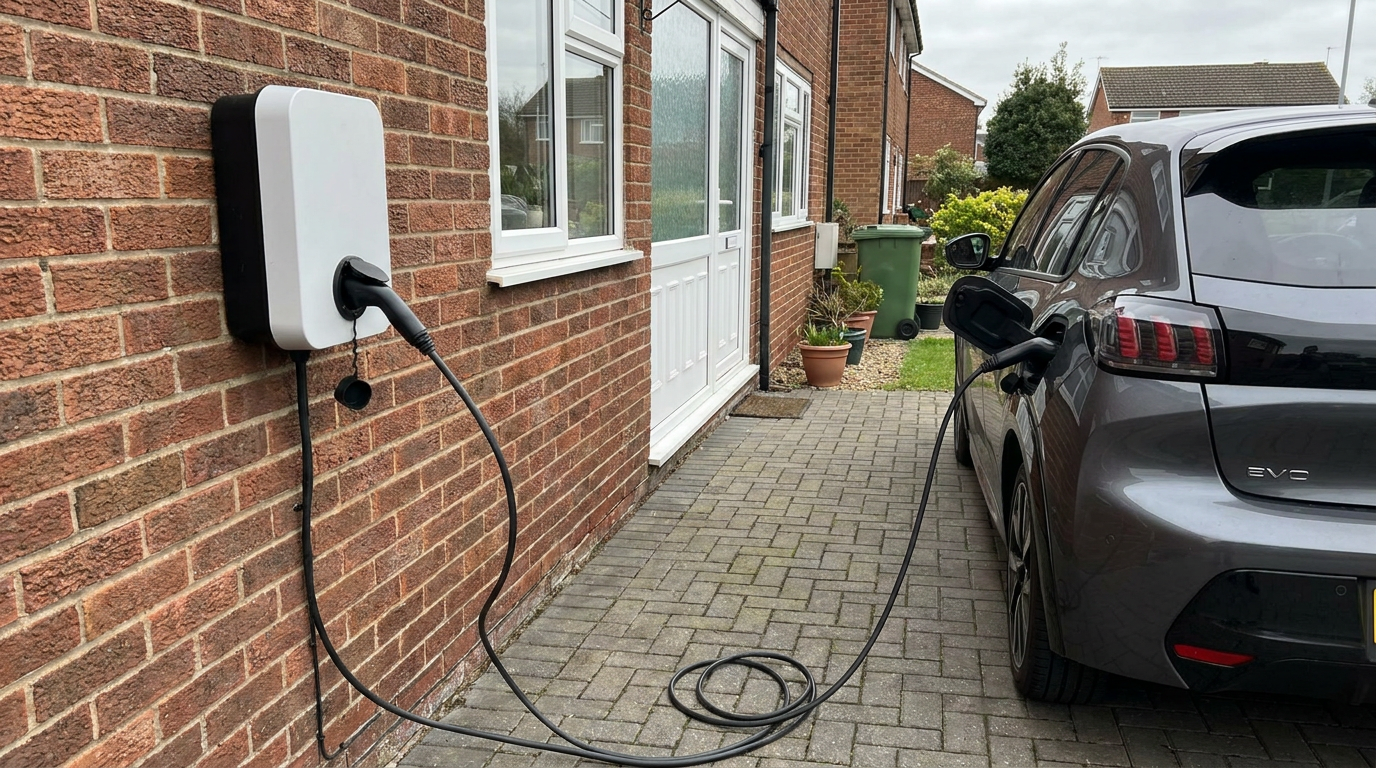
For a standard home charger, supplied and fitted, most people in 2026 are looking at somewhere around £800 to £1,200 all in. That's for the usual setup: a 7kW smart charger on a typical single-phase home supply, mounted within a sensible distance of the fuse box.
Where you land depends mostly on the charger you pick and how far the cable has to run:
A basic 7kW untethered unit can come in from around £700 fitted.
A smart tethered charger from a well-known brand tends to sit higher, roughly £1,000 to £1,600 supplied and fitted.
Longer cable runs, a tricky route, or a consumer unit that needs attention first push it up from there.
Those are national figures. In the South East, where we are, prices tend towards the upper half of the range rather than the bottom, simply because labour costs more here.
Tethered or untethered?
This is the first real decision, and it's genuinely a matter of preference:
A tethered charger has the cable permanently attached. You pull it off the wall, plug it in, done... no fishing a cable out of the boot. The trade-off is you're tied to that connector type and the cable's always on show.
An untethered (socketed) unit is just a socket on the wall; you plug in your own cable each time. It's tidier when not in use, and it's the more flexible choice if you might change cars or want a longer cable later.
Pricewise there's not much in it... a modest difference either way. For most people it comes down to convenience versus tidiness, and either is a perfectly sensible choice.
Why it needs its own dedicated circuit
Here's the part that explains why this isn't a plug-in job. A car charger draws a lot of current, steadily, for hours at a time... far more demanding than a kettle or a washing machine. So it can't just spur off an existing socket. It needs its own dedicated circuit run straight from your consumer unit, correctly sized, on its own protective device.
It also needs the right kind of fault protection. EV charging brings a specific risk, DC fault current, that an ordinary RCD doesn't catch, so the installation has to include the correct protection for that, either built into the charger or fitted separately. Getting that right is exactly the sort of thing that separates a proper install from a cheap one.
In practice, a typical install means: running a new cable from your fuse box to where the charger goes, fitting the dedicated circuit and its protection, mounting and wiring the unit, setting up its smart features, then testing the whole lot and certifying it. On a straightforward home that's often a few hours; if the cable has to travel a long way or round awkward corners, it takes longer.
Is there still a grant?
Short version: probably not if you own a house with a driveway... but possibly yes if you rent or live in a flat. This is worth getting right, because a lot of out-of-date articles still imply there's free money for everyone. There isn't.
The old scheme that paid homeowners closed back in 2022. Standard homeowners with off-street parking are no longer eligible for anything... so if that's you, budget for the full cost.
What does still exist in 2026 is the EV Chargepoint Grant for renters and flat owners (and residential landlords). It covers 75% of the cost of buying and installing a chargepoint socket, up to £500 per socket... that cap actually went up from £350 on 1 April 2026, and the scheme is funded through to 31 March 2027. You need an eligible vehicle, private off-street parking, and the work has to be done by a government-approved installer. If you're a landlord kitting out a rental, or you own a flat, it's well worth checking whether you qualify before you book anything in.
Telling the network you've fitted one
One more step people don't expect: your local network operator, the DNO, which around Slough is SSEN, needs to know a charger's been added, because a street full of them affects the local grid. For a standard 7kW home charger this is usually a straightforward notification the installer submits, not something that holds the job up. A proper installer handles this as a matter of course; it's one more reason not to let a mate "just wire it in".
Is your fuse box up to it first?
This is the one that occasionally changes the plan. A new charger circuit has to land somewhere, and two things have to stack up: your consumer unit needs a spare way (or room to add protection) and the right modern setup, and your main incoming supply needs enough headroom to run a car charger on top of everything else.
Older boards (the ones with rewireable fuses, or no modern RCD protection, or simply no spare capacity) often aren't ready for it. If that's your situation, the sensible order is to sort the board first, then add the charger, rather than bolt a demanding new circuit onto tired old kit. If yours is looking its age, it's worth reading up on when a fuse box replacement makes sense... sometimes doing both together is better value than two separate visits. If you're not sure whether your board's up to it, an inspection and testing report will tell you where you stand before you spend anything on the charger itself.
Why it has to be done properly
An EV charger install is notifiable work under Part P of the Building Regulations... it's a new circuit in your home, and it has to be certified. Because we're NAPIT registered and Part P certified, we can self-certify the work and handle the paperwork, so you're not involving the council. New home chargers also have to be smart chargers by law now, that's what lets you schedule charging for cheap overnight rates, and they have to be installed to the current wiring regulations with the correct fault protection. None of that is optional, and none of it is where you want someone cutting corners on a circuit that runs at full load for hours on end.
Getting a real figure for your home
The ranges above will tell you whether a quote you've been given looks sensible. But the only way to know what your install costs is to have someone look at where the charger's going, how far it is from the board, and whether the board's ready for it... and we can often get a good way there from a few clear photos of your fuse box and the parking spot.
We give free, no-obligation quotes. If your consumer unit needs sorting first, you'll hear about it before we start, not after. To talk it through or get a figure, read more about our work or give us a call on +44 7722 132736. We're a family-run electrical business based in Slough, covering Windsor, Maidenhead and the surrounding area, and we're happy to give you a straight answer.
Got an Electrical Job in Mind?
Friendly, fully-qualified and local. Call B.P.H. Electrics for a straight answer.
Call +44 7722 132736