Garden and outdoor electrics: what's safe, what's legal, and what it costs
Written by B.P.H. Electrics
NAPIT-registered, Part P electrician. Family-run, based in Slough, covering Slough, Windsor, Maidenhead, Reading and the wider Thames Valley.
Come the first stretch of decent weather, the garden jobs pile up: somewhere to plug the mower in without trailing a lead through the kitchen window, a bit of lighting down the path, power to the shed, maybe a hot tub. All very doable... but outdoor electrics play by stricter rules than indoor ones, for good reason. Water, weather and bare earth are exactly the conditions electricity likes least. So here's a plain guide to what's involved, what the law actually requires, the DIY traps worth avoiding, and rough honest prices for the common jobs.
As always: the figures below are typical UK ranges from national cost guides, not a B.P.H. Electrics quote. Every garden is different, and the only way to price yours is to look at it.
Why outdoors is a different game
Indoors, your wiring lives in a dry, stable environment. Outdoors it faces rain, frost, UV, and the occasional spade. Two things matter more than anything else out there:
RCD protection. Every outdoor circuit must be protected by an RCD... the safety device that cuts the power in a fraction of a second if current starts leaking to earth. Outdoors, where damp and damage are far likelier, that protection is what stands between a fault and a serious shock. It's not optional.
IP rating. This is the number that tells you how weatherproof a fitting is... its resistance to dust and water. An outdoor socket or light needs a suitable IP rating (typically IP66 for something exposed to the weather) and a proper weatherproof enclosure. An indoor socket with a plastic flap screwed to an outside wall is not the same thing, whatever it looks like.
Get those two right and outdoor electrics are perfectly safe. Get them wrong and you've built a hazard that looks fine right up until it rains.
Outdoor sockets
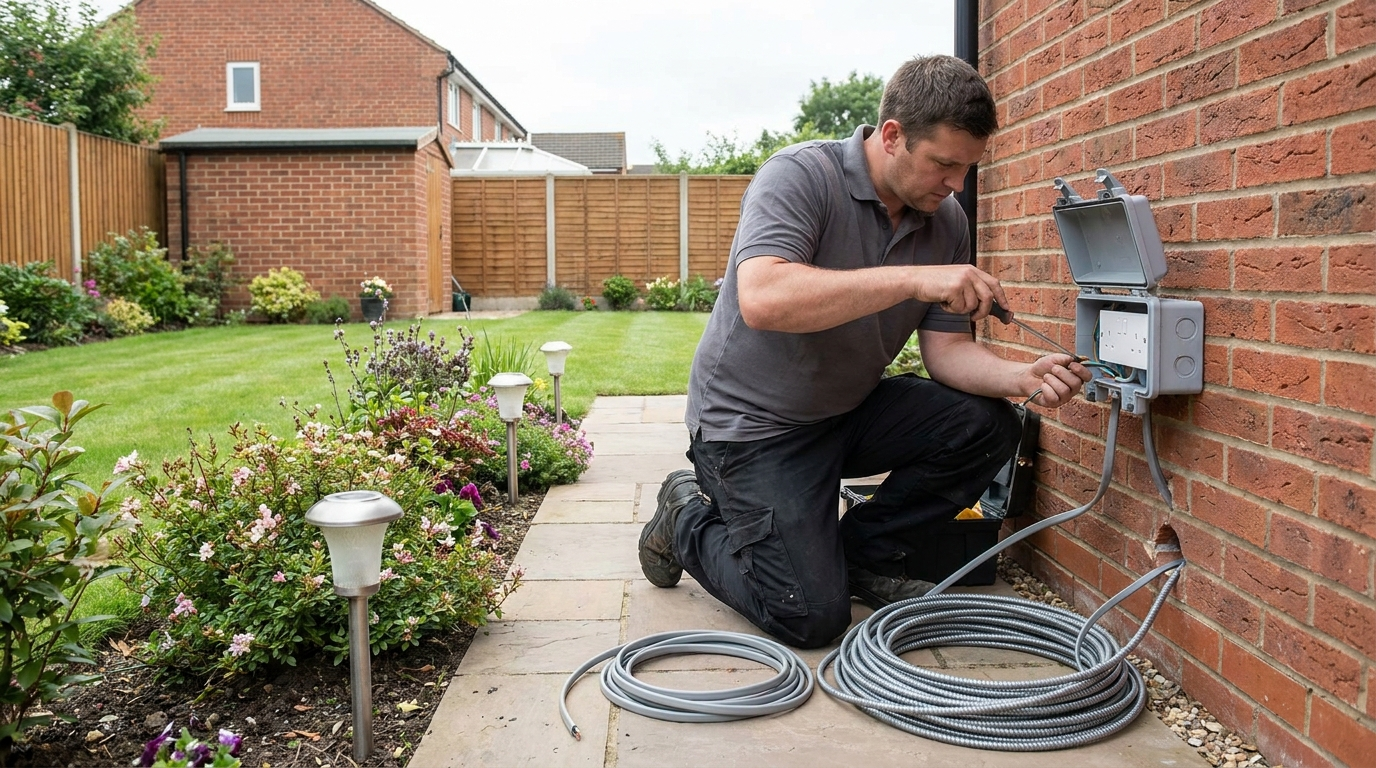
An outdoor socket is the job we're asked for most, and it's a good example of "simple but not trivial". Done properly it's a weatherproof, IP-rated socket, on an RCD-protected circuit, correctly sealed where it passes through the wall so water can't track back inside.
For a straightforward install, a socket on an exterior wall close to the consumer unit, you're typically looking at somewhere around £150 to £300 fitted. A double costs a little more than a single, and the price climbs if the socket's a long way from the board, or the cable has to cross the garden rather than sit on the wall. It's an hour or two of work, but it's work that has to be sealed and tested properly, not just drilled through and hoped for.
Garden lighting
Lighting is where a garden really comes alive in the evening, and there's a lot you can do... path and step lights, uplighting on trees, lighting for a patio or seating area, security floodlights. The wiring behind it needs the same discipline as everything else outdoors: weatherproof fittings, the right IP rating, RCD protection, and cable that's either properly armoured or run at a safe depth in the right ducting.
Low-voltage garden lighting kits sold for DIY are fine as far as they go, but anything wired back into your mains supply is a different matter and needs doing properly. If you're planning something more considered than a string of solar spikes, our lighting installation service covers outdoor and garden lighting designed and wired to last, rather than replaced every couple of summers.
Bigger supplies: sheds, garden rooms, hot tubs
This is where it steps up from "a socket" to "a proper circuit", and where the right cable really matters. Running power across a garden to a shed, a garden room, a hot tub or an outdoor EV point almost always means SWA cable, steel wire armoured cable, either clipped along a run or, more often, buried. That's not us gold-plating it: BS 7671, the wiring regulations, effectively require armoured cable (or equivalent mechanical protection) for buried outdoor runs, because a standard cable in the ground is an accident waiting for the next person with a fork.
These jobs need their own dedicated circuit from the consumer unit, correctly sized for the load, on its own protection. A hot tub in particular is a heavy, sustained load and usually wants a dedicated supply of its own... a proper hot tub or outbuilding supply typically runs somewhere around £400 to £800 depending on the distance from the board, the cable route, and whether your existing board can take another circuit. A longer trench or a full garden room supply costs more again.
The honest bit: much of the cost is the cable run and the digging, not the connection itself. So the sensible move is to plan the route and get the supply in once, properly, rather than in stages.
The DIY dangers worth knowing
Plenty of garden electrics get attempted as weekend jobs, and a few mistakes come up again and again... all of them genuinely dangerous:
Ordinary cable run outdoors or buried. Standard indoor cable outside, unarmoured and shallow, is one of the most common and most serious errors. A spade, a fork or an aerating tool finds it eventually.
Indoor fittings used outside. A non-weatherproof socket or junction box on an exterior wall lets water in. It may work all summer and become live-to-touch in the first real downpour.
No RCD protection. Spurring an outdoor socket off an old circuit with no RCD removes the one thing most likely to save someone from a shock.
Extension leads as a permanent fix. A lead run out to the shed and left there, through the weather, month after month, is not a solution... it's a hazard people stop noticing.
Damp getting into any of this is also the classic reason an RCD keeps tripping... which, annoying as it is, is the safety device doing its job. If your outdoor sockets or lights trip after rain, that's a fault to trace, not a nuisance to ignore.
It's the law, too
Beyond the safety of it, there's a legal side people often don't realise. Installing new outdoor circuits (a new socket circuit, a supply to a hot tub or garden building, garden lighting on a new circuit) is notifiable work under Part P of the Building Regulations. It has to be designed and installed to the wiring regulations, tested, and certified.
Because we're NAPIT registered and Part P certified, we can self-certify outdoor work and handle the notification for you... no council involvement, no separate inspection fee. That certificate matters for your insurer and for when you eventually sell, and it's your proof the job was done to standard. A cash-in-hand socket with no paperwork is worth exactly nothing on both counts.
One more thing worth a quick check: adding several new outdoor circuits (sockets, lights, a hot tub supply) asks more of your consumer unit, and older boards sometimes don't have the spare capacity or the modern RCD protection to take it. If yours is due some attention anyway, it's worth reading up on when a fuse box replacement makes sense before you start adding to it.
Getting your garden sorted properly
Whether it's a single outdoor socket or power and lighting across the whole garden, the ranges above will tell you whether a quote looks sensible... but the only way to price your job is to see the route, the distances, and the state of your board.
We give free, no-obligation quotes, and for garden work we're happy to walk it with you and lay out the options honestly, including which bits are genuinely worth doing now and which can wait. To talk it through, see more about our lighting and installation work or give us a call on +44 7722 132736. We're a family-run electrical business based in Slough, covering Windsor, Maidenhead and the surrounding area, and we'll give you a straight answer.
Got an Electrical Job in Mind?
Friendly, fully-qualified and local. Call B.P.H. Electrics for a straight answer.
Call +44 7722 132736