Written by B.P.H. Electrics
NAPIT-registered, Part P electrician. Family-run, based in Slough, covering Slough, Windsor, Maidenhead, Reading and the wider Thames Valley.
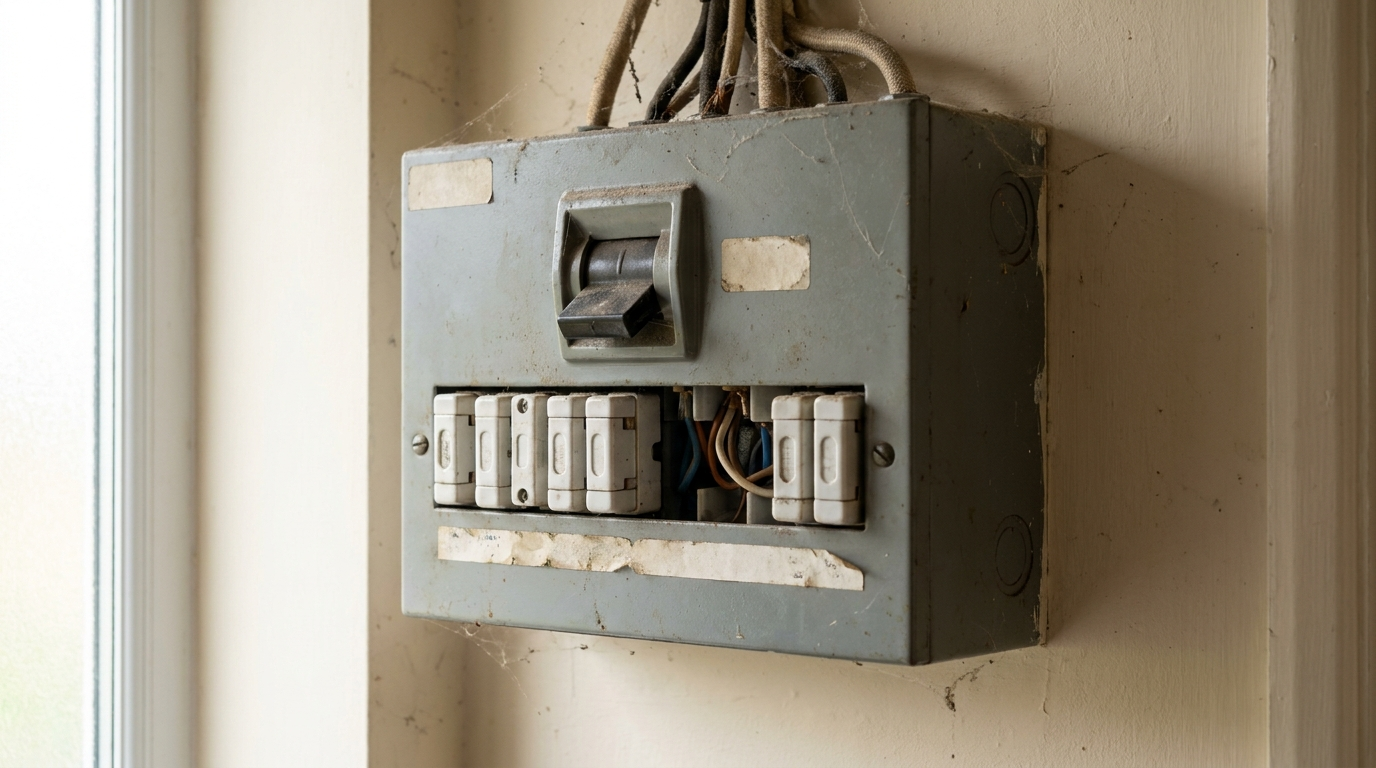
Your fuse box (or consumer unit, to give it its proper name) is the heart of your home's electrical system. It's the grey (or, in older homes, cream or black) box that everything runs through, and when it's working well you never think about it. The trouble is, plenty of homes are running on boards that are twenty, thirty, even forty years old, quietly doing a job they were never designed to do to today's standards.
Fuse box replacement is our core speciality, so we see a lot of these. Here are five signs that yours might be ready for an upgrade... and, honestly, a couple of things that don't mean you need one, because we'd rather you didn't spend money you don't have to.
1. It still has old-style rewireable fuses
If you open your fuse box and see rows of little ceramic or plastic holders that you pull out (with a length of fuse wire inside that you replace when it "blows"), that's the clearest sign of all. These are old-technology boards, and they don't offer anything like the protection of a modern unit.
The big thing they lack is RCD protection. An RCD (residual current device) is a safety switch that cuts the power in a fraction of a second if it detects electricity leaking to earth... the kind of fault that can give you a serious or fatal shock. A rewireable fuse simply can't do that. If your board is the fuse-wire kind, upgrading isn't about fashion; it's a genuine safety improvement.
2. There's no RCD at all
Even some boards that look reasonably modern, with switches rather than fuse wire, have no RCD. The giveaway is that there's no "test" button anywhere on the unit. Modern RCDs have a little T or Test button you're meant to press every so often to check it still trips.
No test button usually means no RCD, and no RCD means the shock protection described above simply isn't there. This matters most for the circuits that feed sockets and anything used outdoors, which is exactly where accidents tend to happen. If you're not sure whether yours has one, that's worth getting checked.
3. It trips constantly... or a fuse keeps blowing
An RCD that occasionally trips is doing its job. An RCD that trips again and again, or a fuse that keeps blowing on the same circuit, is telling you something's wrong. Sometimes it's a single faulty appliance. Sometimes it's a fault in the wiring. And sometimes it's an old, tired board that's become oversensitive and trips at the slightest thing.
The important point: repeated tripping is a symptom, not something to keep resetting and hoping. It needs diagnosing before you decide whether the board itself is the problem. Our fault finding page explains how we track down the cause... because there's no sense replacing a fuse box if the real fault is a leaking immersion heater. Get the diagnosis first, then decide.
4. Signs of heat, scorching or a burning smell
This one you should never ignore. Any sign of overheating at the consumer unit (scorch marks, discolouration around the fuses or switches, a faint smell of burning plastic, or the board feeling warm to the touch) is a red flag. It can point to a loose connection or a circuit that's been overloaded for years, and either can start a fire.
If you notice this, switch off at the main switch if you can do so safely and get it looked at straight away rather than waiting. This is the sort of thing our 24/7 emergency electrician service exists for... and if it's ever accompanied by smoke or sparking, treat it as an emergency and call 999 first.
5. Your home is older and the board has never been touched
If your property is more than a couple of decades old and still has its original consumer unit, the odds are it no longer meets current standards... and it may be struggling with a modern household's demands. When these boards were fitted, homes didn't have electric showers, multiple kitchen appliances, EV chargers on the drive and a device charging in every room. Old boards can end up permanently near their limit.
Age alone isn't proof you need a new board... but it's a strong prompt to have it assessed, especially if you've never had the installation properly checked.
The honest bit: when you don't need a new one
We're fuse box specialists, but we're not in the business of selling upgrades no one needs. A board that's simply a bit old, has a working RCD with a test button, and isn't tripping or overheating may be perfectly safe to keep using for now. And a single tripping circuit is often a faulty kettle or washing machine, not a reason to rip out the whole board.
The reliable way to know for certain is an inspection. An EICR (Electrical Installation Condition Report) gives you a professional verdict on the whole installation, including the consumer unit, so you're deciding on evidence, not guesswork. If your board's fine, we'll say so.
If a few of these ring true
If you've read this and recognised two or three of the signs above, it's worth getting your board looked at sooner rather than later. Upgrading to a modern consumer unit with full RCD protection is one of the most worthwhile safety improvements you can make to a home, and it's usually a single day's work.
You can read more about what a fuse box replacement involves, or just call us on +44 7722 132736 for a free, no-obligation chat. We're a family-run electrical business in Slough, covering Windsor, Maidenhead and the wider Thames Valley, and we're always happy to tell you honestly whether it's a job worth doing yet.
Got an Electrical Job in Mind?
Friendly, fully-qualified and local. Call B.P.H. Electrics for a straight answer.
Call +44 7722 132736